
FAQs About Peer-to-Peer Knowledge Sharing
Peer-to-peer knowledge sharing is a practical way for employees to learn from each other, leveraging their collective expertise to solve everyday challenges at work. Unlike traditional training, this approach focuses on collaboration and real-world problem-solving, making it more relevant and effective. Here’s why it matters:
- 55% of employees prefer learning from colleagues over other sources.
- Companies with strong learning cultures see a 57% increase in employee retention.
- Poor knowledge sharing costs businesses an average of $47 million annually.
By creating systems for sharing expertise, organizations reduce repetitive questions, improve collaboration, and preserve critical knowledge. Tools like AI-powered knowledge bases help make information accessible, while structured participation frameworks encourage employees to contribute. The result? Teams that are more independent, productive, and engaged.
Let’s explore how peer-to-peer knowledge sharing works, its benefits, and actionable steps to implement it effectively.
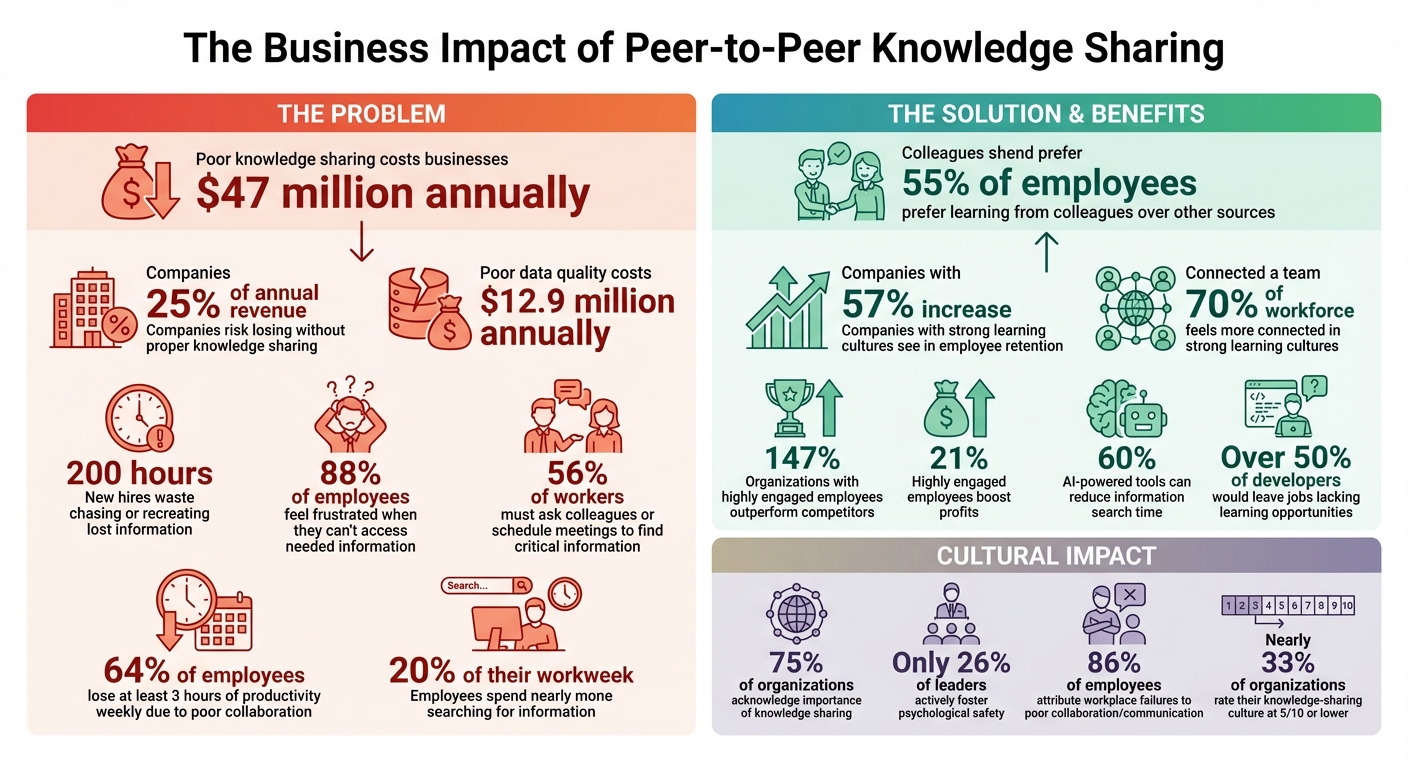
The Business Impact of Peer-to-Peer Knowledge Sharing: Key Statistics
Benefits of Peer-to-Peer Knowledge Sharing
Better Knowledge Retention and Transfer
When employees share what they’ve learned with colleagues, they reinforce their own understanding through something called the "learning-by-teaching effect". This process taps into what’s known as the "Learning Loop" - a cycle of gaining knowledge, applying it, receiving feedback, and reflecting. It’s a method that not only enhances training but also strengthens memory retention. Research shows that companies with strong learning cultures see a 57% increase in employee retention and foster a sense of connection among 70% of their workforce.
Sharing and documenting key expertise ensures that institutional knowledge remains intact, even when team members leave. This is critical because 88% of employees feel frustrated when they can’t access the information they need to do their job. Collaborative learning often beats theoretical approaches, helping employees internalize essential details. This deeper understanding doesn’t just improve knowledge retention - it also builds more capable, self-reliant teams.
Stronger Collaboration and Team Independence
Improved knowledge retention naturally leads to better collaboration and greater team independence. Sharing knowledge breaks down silos, transforming experts into trusted advisors. Suyog Rao, Director of Engineering at Elastic, explained it well:
Engineers should help solve the hardest questions, the unknowns, where being familiar with how the product was built is essential... but we don't want to keep answering solved problems over and over again.
By creating searchable knowledge repositories, employees can find answers on their own, reducing reliance on specific individuals. For example, when Runtastic scaled to 250 employees, Head of Engineering David Österreicher moved the team away from ad-hoc Slack messages to static documentation. This shift ensured that engineers weren’t constantly repeating explanations to new hires. The results speak for themselves: organizations with highly engaged employees - often driven by strong knowledge-sharing cultures - outperform their competitors by 147%.
Fewer Repetitive Questions
Structured knowledge sharing also cuts down on repetitive questions. When information is recorded and easily searchable, employees develop a "search before you ask" habit, reducing the need to repeatedly consult experts. If a question keeps coming up, its answer can be captured as a permanent, accessible resource. This is crucial because 56% of workers say they often have to ask colleagues or schedule meetings to find critical information. Poor collaboration, meanwhile, costs 64% of employees at least three hours of productivity every week.
At Intuit, Senior Software Engineer Matt Madson introduced a centralized knowledge platform to address this issue. Support staff had been frequently interrupted with requests for information that was already documented elsewhere. Modern AI-powered tools can further streamline this process, cutting the time spent searching for information by up to 60%. This allows teams to focus on more meaningful work. As General Stanley McChrystal put it:
Information is only of value if you give it to people who have the ability to do something with it... sharing is power.
sbb-itb-a0a3b44
How to Implement Peer-to-Peer Knowledge Sharing
Identify Knowledge Gaps and Set Clear Goals
Start by pinpointing where knowledge is missing and where it’s needed. Did you know inefficient knowledge sharing costs businesses a staggering $47 million annually?. One way to uncover gaps is by reviewing Slack or email threads for repeated questions - these often highlight areas where documentation is lacking. Another approach is to track search behavior. If employees frequently search for information and come up empty-handed, that’s a clear signal. It’s also crucial to identify who holds critical expertise so you’re not left scrambling when they leave the company.
Take Runtastic as an example. When their team grew to 250 people, they moved from answering the same questions repeatedly on Slack to creating static documentation in Atlassian Confluence.
Once you know where the gaps are, set measurable goals. For instance, consider this: on average, new hires spend 200 hours chasing down or recreating lost information. Additionally, 56% of employees say they can only find essential knowledge by asking a colleague or setting up a meeting. Define what success looks like for your team - whether it’s reducing time spent searching for answers, preventing knowledge loss during transitions, or boosting employee retention.
With your goals in place, you can turn to technology to make the sharing process more efficient.
Use Technology for Asynchronous Sharing
The right tools can make knowledge sharing feel seamless. Modern platforms don’t just store information - they actively deliver it when and where it’s needed. In fact, AI-powered solutions can cut information retrieval time by up to 60%.
Asynchronous tools are a game-changer, especially for teams spread across time zones. They allow employees to share and access knowledge on their own schedules without adding to meeting fatigue. For instance, platforms like UnSoloMind (https://unsolomind.com) let teams upload documents, notes, and FAQs to build a searchable knowledge base. With AI-powered chat features, employees can get instant answers to common questions any time of day. By integrating these tools into everyday platforms like Slack or Microsoft Teams, you minimize disruptions and make knowledge sharing part of the workflow. Automations can even suggest relevant documentation when recurring questions pop up.
Here’s a practical example: At Box, Product Manager Aiko Krishna introduced a Slack integration where team members used specific tags to highlight their expertise. During daily stand-ups, the team reviewed unanswered questions and volunteered to document the answers. This simple system ensured that valuable insights weren’t lost in endless chat threads.
Build a Framework for Participation
Technology is helpful, but it’s not enough on its own. To create a culture of sharing, you need clear structures that encourage participation. It starts with leadership. When leaders actively share knowledge - whether through fireside chats, AMAs, or by publicly recognizing employees’ contributions - it sends a strong message that sharing matters.
Suyog Rao, Director of Engineering at Elastic, put it this way:
Engineers should help solve the hardest questions, the unknowns, where being familiar with how the product was built is essential... but we don't want to keep answering solved problems over and over again.
Make knowledge sharing part of your onboarding process. Pair new hires with mentors to help them get up to speed faster. Rotate leadership roles during weekly check-ins to showcase a variety of expertise. Set default permissions to “open” so information is accessible and searchable across teams, reducing unnecessary gatekeeping.
Recognition can also go a long way. At Doctolib, full-stack engineer Fábio Guerreiro found motivation in gamification features like points, achievements, and medals. He explained:
As an engineer, you work towards targets, but you also work for recognition from your co-workers. This tool helps me get both.
Incorporate upvotes, badges, and public shoutouts to shift the mindset from “knowledge is power” to “sharing is power”. And don’t forget regular upkeep - archive outdated content and clearly label work-in-progress to keep things organized.
Building a Knowledge Sharing Culture
Recognize and Reward Contributions
While 75% of organizations acknowledge the importance of knowledge sharing, nearly a third rate their culture at just 5 out of 10 or lower. This disconnect often stems from a lack of motivation, especially when employees don't see clear benefits.
People may hold back from sharing their expertise if they fear losing their edge or think their efforts won't be acknowledged [26, 31]. To address this, make recognition visible and meaningful. For example, create a "Knowledge Sharer of the Month" program or use gamification techniques like points, badges, or leaderboards to encourage participation. Tie these efforts to performance reviews and offer tangible rewards such as gift cards or additional vacation days [26, 31, 34]. These methods not only incentivize sharing but also help integrate it into the organization's culture. As content marketer Adela Belin points out:
You might assume that because knowledge sharing is vital to the organization, that it will also be critical for employees. In truth, it won't matter to them until you make it a priority or attach an incentive to it.
Beyond recognition, fostering psychological safety is equally important to encourage an open and collaborative environment.
Create Safe Learning Spaces
Psychological safety forms the backbone of a successful knowledge-sharing culture. Employees need to feel secure admitting gaps in their knowledge without fearing embarrassment or consequences [10, 32]. Yet, only 26% of leaders are seen as actively fostering this kind of safety, and 86% of employees attribute workplace failures to poor collaboration or ineffective communication.
Leaders can set the tone by being transparent about their own challenges, modeling vulnerability, and fostering trust [30, 32, 11]. Harvard Business School's Amy Edmondson emphasizes this point:
When people have psychological safety at work, they feel comfortable sharing concerns and mistakes without fear of embarrassment or retribution.
Simple steps like dedicating the first 10 minutes of meetings to casual conversation or icebreakers can help build trust. Anonymous feedback channels, such as digital suggestion boxes, also allow employees to contribute without fear of judgment [30, 32]. Organizations that prioritize psychological safety and trust often see impressive results - companies with highly engaged employees can outperform their competitors by up to 147%.
Creating this safe environment lays the groundwork for continuous feedback and ongoing cultural improvement.
Collect Feedback for Continuous Improvement
Developing a knowledge-sharing culture isn't a one-and-done effort - it requires constant fine-tuning. Regular feedback loops, such as surveys or one-on-one discussions, can help identify pain points like outdated content, silos, or gaps in documentation [31, 32]. Incorporating brief "knowledge moments" into meetings or using asynchronous tools can make sharing more accessible for busy teams [26, 32, 11].
Breaking down silos is also key. Consider hosting cross-functional forums or adopting an "open by default" communication policy. Periodic audits can help ensure content remains relevant and up to date [26, 11]. These ongoing efforts help keep the culture dynamic and aligned with organizational goals.
Why Peer-to-Peer Learning is Important | Fastest Way to Learn at Work
Technology's Role in Peer-to-Peer Knowledge Sharing
Technology has become a game-changer in making knowledge sharing more seamless and efficient. Without the right tools, employees spend nearly a fifth of their workweek searching for information, with over half relying on colleagues or meetings to track down critical details. Modern platforms streamline this process by integrating answers directly into daily workflows, cutting down on the constant app-switching that disrupts productivity. This shift in efficiency sets the stage for exploring the features that make these platforms effective.
Key Features of Knowledge Sharing Platforms
The best knowledge-sharing platforms combine several standout features to simplify the flow of information. For starters, AI-powered search pulls data from tools like Slack, Google Drive, and Jira, delivering precise answers in seconds. This can reduce the time spent searching for information by as much as 60%. These systems don't just wait for users to search - they proactively surface relevant content right when it's needed.
Another critical feature is crowdsourced validation, which ensures the accuracy of shared knowledge. Features like upvoting, "best answer" tags, and content status labels (e.g., current or outdated) help prioritize reliable information, cutting down on the need for managerial oversight.
Platforms that support multimedia also stand out. For example, integrating tools like Loom allows teams to turn meetings into searchable transcripts or explain complex workflows through video, which is often more effective than long-form text. A practical example is Microsoft's internal launch of Stack Overflow in 2022. Thanks to developers' familiarity with the platform, it saw widespread adoption and engagement from day one.
Why Asynchronous Solutions Matter
Asynchronous platforms are a lifesaver for distributed teams working across multiple time zones. They let team members access shared knowledge at their convenience, eliminating delays and interruptions. This "open by default" approach makes decisions and progress visible in searchable formats, reducing disruptions while promoting transparency.
Take UnSoloMind as an example. This platform allows teams to upload documents, notes, and FAQs into a smart, searchable knowledge base. With AI-powered chat features, employees can get instant answers to common questions without having to bother colleagues. This directly addresses a challenge highlighted by Suyog Rao, Director of Engineering at Elastic:
Engineers should help solve the hardest questions, the unknowns, where being familiar with how the product was built is essential...but we don't want to keep answering solved problems over and over again.
The benefits go beyond convenience. Businesses with highly engaged employees - often driven by effective knowledge-sharing systems - can see a 21% boost in profits. Plus, over 50% of developers say they'd consider leaving a job that doesn't offer enough learning opportunities. Asynchronous solutions not only enhance productivity but also help retain top talent.
Track Metrics to Measure Success
To keep knowledge-sharing systems effective, tracking the right metrics is key. These metrics help identify what’s working and where improvements are needed. For example, search abandonment - when users search but don’t click on results - can highlight areas where content is missing or poorly organized. Click-through rates reveal whether search results align with user needs, while resolution rates show how often users find answers without needing further help.
It's also important to monitor contribution patterns to see which experts are actively sharing knowledge and whether participation spans across teams. This ensures that no critical areas are overlooked.
Regularly analyzing these metrics keeps the knowledge base dynamic and useful. For instance, when Runtastic grew to 250 employees, they moved from ad-hoc Slack discussions to structured documentation using Atlassian Confluence and Stack Overflow. This shift helped reduce repetitive questions and ensured engineers weren’t wasting time answering the same queries. Quarterly reviews can further refine the system by identifying outdated content for removal and spotting gaps where new documentation is needed. This method turns a static repository into a living, responsive resource.
Conclusion and Next Steps
Peer-to-peer knowledge sharing isn't just helpful - it's essential. Companies that don't prioritize it risk losing up to 25% of their annual revenue. On top of that, poor data quality alone can cost an average organization around $12.9 million annually. On the other hand, businesses with highly engaged employees - often fueled by strong knowledge-sharing systems - outperform their competitors by a staggering 147%. These numbers highlight why knowledge sharing should be at the core of any business strategy.
Start by securing leadership involvement. When executives participate in AMAs or openly discuss both wins and failures, it sets the tone for the entire organization. Genevieve Michaels from Atlassian sums it up perfectly:
One person's knowledge isn't enough to execute the work that really matters. Even your team can't go it alone. To make great things happen, your entire organization must pool their cognitive resources.
Next, centralize your information. A cloud-based, searchable repository becomes the single source of truth, eliminating the confusion caused by scattered documents. This ensures everyone has access to accurate, up-to-date data.
Make knowledge sharing part of your team's daily routine. Use tools that integrate seamlessly with platforms like Slack or Teams to keep everything in one place and reduce unnecessary context-switching. For example, UnSoloMind is a tool that allows teams to upload documents, notes, and FAQs into a smart, searchable knowledge base. Its AI-powered chat features provide instant answers to common questions, lightening the load on senior team members and cutting down on repetitive queries.
Finally, track your progress. Focus on metrics like search success rates, time saved in finding information, and patterns of contribution. Quarterly audits can help you keep the knowledge base relevant by removing outdated content and identifying areas where new documentation is needed. These steps ensure that your system evolves alongside your organization.
Don't wait to get started. Even setting aside 30 to 60 minutes a week for team knowledge-sharing sessions can make a big difference. The payoff is quick - consider that a new hire typically spends 200 hours trying to locate or recreate lost information. By fostering a culture of sharing, you'll not only boost productivity but also create a workplace where employees feel valued and want to stay. This final step cements the foundation for a thriving, collaborative environment.
FAQs
What are the best ways for organizations to implement peer-to-peer knowledge sharing?
Organizations can make peer-to-peer knowledge sharing a success by promoting collaboration and open communication. This starts with creating an environment where transparency and trust are valued. Simple steps like organizing team meetings, encouraging group projects, or using digital tools can provide both formal and informal spaces for sharing ideas. Leadership is crucial here - they need to set the tone by demonstrating these behaviors and championing ongoing learning.
Digital platforms and centralized knowledge bases are powerful tools to streamline the process. They make it easier for team members to share and access information, cutting down on repetitive questions and breaking down knowledge silos. Activities like peer coaching or group problem-solving sessions can also strengthen these habits and make sharing a natural part of the workflow.
Of course, challenges like resistance to change can arise. Tackling this requires consistent support, training, and recognizing those who actively contribute. By weaving these practices into everyday operations and leveraging platforms like UnSoloMind, organizations can build a culture where knowledge sharing becomes second nature, boosting both creativity and efficiency.
How does technology improve knowledge sharing in the workplace?
Technology has transformed how knowledge is shared in the workplace, streamlining the process and making it more efficient. Platforms like UnSoloMind allow teams to exchange information asynchronously through smart, searchable knowledge bases. Employees can upload resources like documents, notes, and FAQs, which are instantly accessible via AI-powered chat. This not only cuts down on repetitive questions but also boosts productivity by keeping information at everyone's fingertips.
These tools also play a key role in fostering collaboration. By integrating knowledge-sharing systems into everyday workflows, they help organize information, promote transparency, and encourage continuous learning. For teams working remotely or across different locations, these platforms ensure employees can access and contribute to shared knowledge anytime, fueling both innovation and adaptability within organizations.
Why is psychological safety essential for effective knowledge sharing?
Psychological safety plays a key role in promoting knowledge sharing within teams. It establishes a space where individuals feel comfortable expressing ideas, asking questions, or even acknowledging mistakes - without worrying about judgment or negative repercussions. This kind of openness lays the groundwork for stronger collaboration, trust, and respect among team members, all of which are essential for sparking creativity and fostering ongoing learning.
When team members feel secure, they’re more inclined to share their expertise and perspectives, which enhances teamwork and problem-solving. It also helps eliminate obstacles like the fear of criticism or feeling undervalued, ensuring knowledge moves smoothly throughout the organization. By prioritizing psychological safety, teams can cultivate an atmosphere that encourages transparency, innovation, and collective progress.